Topics
Every maths topic, every resource, in one place. Search, filter, and find exactly what you need — whether you’re teaching, revising, or supporting your child.
How Topics Work
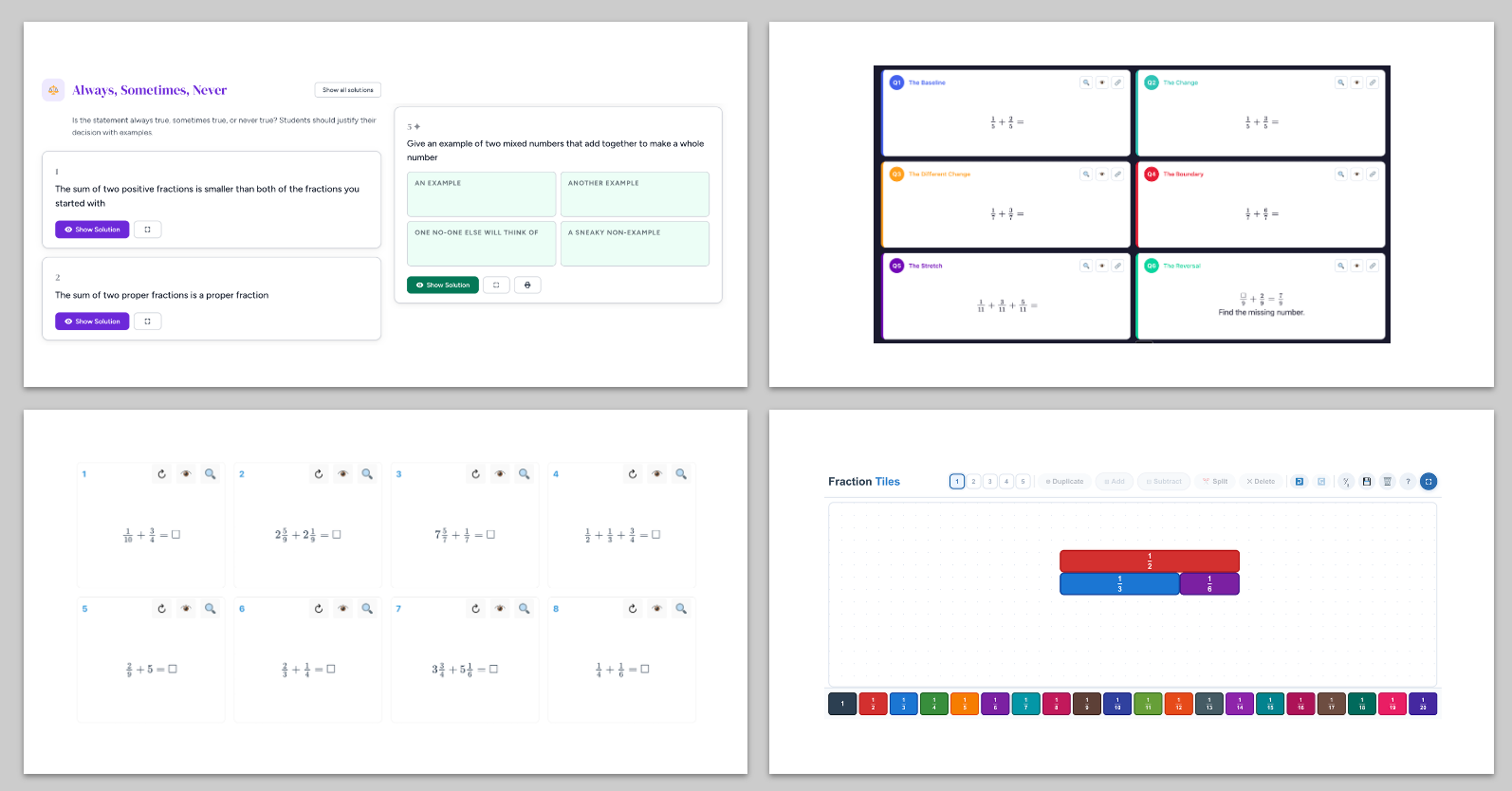
✓ Every maths topic, organised by strand
✓ Search to find any topic instantly
✓ Filter by the resources you love to use
✓ Click icons to jump straight to a resource
✓ Multiple resources per topic, where available
✓ New resources added all the time
✓ Works on desktop, tablet and phone
How to Use Topics
👩🏫
Teachers
Find every resource for the topic you’re teaching, in one place. Plan a lesson, set homework, or grab something for tomorrow.
Tip: Filter by resource type to see only the formats you love.
📚
Students
Stuck on a topic? Search to find it, then pick a resource to practise with — quick questions, deeper challenges, or games.
Tip: Try a few different resources for the same topic.
👨👩👧
Parents
Support your child by finding resources that match what they’re learning in class. No preparation needed.
Tip: Click a resource-type icon to see what it’s like.
Get the most out of this tool
This page helps you find the resources. The books help you decide what to do with them.
The Topics page hands you Interactive Tools, Super 8s, Shedloads, Open Middle problems and more for any topic on the curriculum. What it can’t do is the rest of the work: choosing which resource type fits the moment, getting students to do the practice properly when they’re sitting in front of a worksheet, and pushing all students beyond fluency into the kind of thinking real mathematicians do. That’s what these two books in the Tips for Teachers guide to… series are for.

Tips for Teachers guide to…
Independent Practice
Students often take a cognitive break the moment they’re asked to work independently. This book covers task choice, instructions students actually listen to, the crucial first 30 seconds, effective circulation, and going through the answers without losing the room.
Find out more →
Tips for Teachers guide to…
Purposeful Practice and Problem-Solving
Consolidating procedures matters, but it isn’t everything. This book showcases six activity structures — the kind that turn Open Middle problems, Variation 6s and Rich Tasks into genuine mathematical thinking — with tips for running each in the classroom.
Find out more →The Eleven Resource Types
The coloured icons you’ll see next to each topic below match these. Click any card to learn more about that resource type.
Interactive Tools
Hands-on manipulatives and explorers for investigating maths concepts.
Categorical Atoms
Short yes/no teaching sequences with carefully chosen examples and non-examples.
Super 8s
Eight focused questions with step-by-step solutions for instant practice.
Shedloads of Practice
Large, varied banks of questions for consolidation and fluency.
Ultimate Timed Challenges
Fast-paced, timed games to build speed and recall.
Variation 6
Six-question sets built on variation theory to deepen understanding.
Open Middle Problems
Problems with one answer but multiple paths, to promote reasoning.
Venn Diagrams
Categorisation tasks that surface misconceptions through example-sorting.
Probing Questions
Discussion prompts to test and deepen understanding through dialogue.
Standards Units
Card-sorting, matching and discussion tasks from the classic Improving Learning in Mathematics resource.
Rich Tasks
Extended open-ended investigations for deeper mathematical exploration.
No topics match your search
Try a different term, or clear the filters.
Number
15 domains · 428 topics
Counting
- Subitising
- Counting within 10
- Counting within 20
- Counting within 100
- Skip counting in 2s
- Skip counting in 5s
- Skip counting in 10s
- Skip counting in 2s, 5s, 10s (combined)
- Skip counting in 3s
- Skip counting in 4s
- Skip counting in 8s
- Skip counting in 3s, 4s, 8s (combined)
- Skip counting in 20s
Number lines
- Number lines within 20
- Number lines with positive integers
Comparing & ordering
- What is an integer?
- Comparing positive integers
- Ordering positive integers
- Odd and even numbers
Reading & writing numbers
- Reading numbers to 100
- Writing numbers to 100
- Reading and writing numbers to 100 (combined)
- Reading larger numbers
- Writing larger numbers
- Reading and writing larger numbers (combined)
- Roman numerals
Understanding place value
- Place value of tens and ones
- Place value of hundreds, tens and ones
- Place value of 4-digit numbers
- Place value of 5 and 6-digit numbers
- Place value of 7-digit numbers and beyond
- Place value of larger integers (combined)
- The role of zero in place value
- Standard partitioning (place value decomposition)
- Flexible partitioning
Comparing using place value
- Comparing numbers using place value
- Ordering numbers using place value
Powers of 10
- Finding 1 more
- Finding 10 more
- Finding 100 more
- Finding 1, 10, 100 more (combined)
- Finding 1 less
- Finding 10 less
- Finding 100 less
- Finding 1, 10, 100 less (combined)
- Multiplying integers by 10
- Multiplying integers by 100
- Multiplying integers by 1000
- Multiplying integers by 10, 100, 1000 (combined)
- Dividing integers by 10
- Dividing integers by 100
- Dividing integers by 1000
- Dividing integers by 10, 100, 1000 (combined)
- Multiplying and dividing integers by 10, 100, 1000 (combined)
- Related calculations using place value
Part-whole & number bonds
- Part-whole models
- Number bonds to 5
- Number bonds to 10
- Number bonds to 20
- Number bonds to 50
- Number bonds to 100
- Number bonds to 1000
- Number bonds (combined diagnosis)
- Bar models for addition and subtraction fact families
Mental addition
- Addition within 10
- Addition within 20 (no crossing 10)
- Addition within 20 (crossing 10)
- Adding a single-digit number (no crossing)
- Adding a single-digit number (crossing 10)
- Adding multiples of 10
- Adding a near-multiple of 10
- Adding two 2-digit numbers (no crossing)
- Adding two 2-digit numbers (crossing 10)
- Adding across 100
- Mental addition with larger numbers
Mental subtraction
- Subtraction within 10
- Subtraction within 20 (no crossing 10)
- Subtraction within 20 (crossing 10)
- Subtracting a single-digit number (no crossing)
- Subtracting a single-digit number (crossing 10)
- Subtracting multiples of 10
- Subtracting a near-multiple of 10
- Subtracting two 2-digit numbers (no crossing)
- Subtracting two 2-digit numbers (crossing 10)
- Subtracting across 100
- Mental subtraction with larger numbers
Doubling, halving, and more
- Doubling
- Halving
- Doubling and halving (combined)
- Trebling
- Quadrupling
- Finding a third
- Finding a quarter
Times tables & division facts
- Times tables (2, 5, 10)
- Division facts (2, 5, 10)
- Times tables (3, 4, 8)
- Division facts (3, 4, 8)
- Times tables (all up to 12×12)
- Division facts (all up to 12×12)
- Times tables and division facts (combined diagnosis)
- Three-number multiplication using times tables facts
Order of operations
- Order of operations (basic)
- Order of operations (brackets)
- Order of operations (powers)
- Order of operations combined
- Four operations in context
Written addition
- Column addition (no carrying)
- Column addition (with carrying)
- Column addition (combined diagnosis)
Written subtraction
- Column subtraction (no exchanging)
- Column subtraction (with exchanging)
- Column subtraction (combined diagnosis)
Written multiplication
- Short multiplication
- Long multiplication
Written division
- Short division
- Long division
- Interpreting remainders
Calculator skills
- Basic calculator use
- Advanced calculator use
Factors & multiples basics
- What is a factor?
- What is a multiple?
- Factor or multiple? — combined
- Factors of a number
- Multiples of a number
- Factor pairs
- Divisibility rules
- Factors and multiples (combined diagnosis)
Prime numbers
- What is a prime number?
- What is a composite number?
- Identifying prime numbers
- Prime factorisation
- Factors from prime factorisation
HCF & LCM
- HCF by listing
- LCM by listing
- HCF by prime factorisation
- LCM by prime factorisation
- HCF and LCM problems
Systematic listing
- Listing combinations
- Listing arrangements
- Listing selections (order doesn’t matter)
- The product rule for counting
Understanding negatives
- Number lines with negative integers
- Comparing negative numbers
- Ordering negative numbers
- Negative decimals on a number line
- Negative numbers in context
Operations with negatives
- Adding negative numbers
- Subtracting negative numbers
- Adding and subtracting negative numbers (combined)
- Multiplying negative numbers
- Dividing negative numbers
- Multiplying and dividing negative numbers (combined)
- Mixed operations with negatives
Recognising & counting money
- Recognising coins and notes
- Counting coins and notes
- Money notation and comparison
Operations with money
- Adding money
- Subtracting money
- Adding and subtracting money (combined)
- Multiplying money
- Dividing money
- Problem-solving with money
Rounding and truncating
- Rounding to the nearest 10
- Rounding to the nearest 100
- Rounding to the nearest 1000
- Rounding to the nearest 10, 100, 1000 (combined)
- Rounding to the nearest whole number
- Identify the first decimal place
- Identify the second decimal place
- Identify the third decimal place
- Identifying decimal places — combined
- Rounding to 1 decimal place
- Rounding to 2 decimal places
- Rounding to 3 or more decimal places
- Rounding to decimal places (combined)
- Identify the first significant figure
- Identify the second significant figure
- Identify the third significant figure
- Identifying significant figures — combined
- Rounding to 1 significant figure (large numbers)
- Rounding to 2 or more significant figures (large numbers)
- Rounding to significant figures (large numbers, combined)
- Rounding to 1 significant figure (small numbers)
- Rounding to 2 or more significant figures (small numbers)
- Rounding to significant figures (small numbers, combined)
- Rounding to significant figures (combined)
- Identifying decimal places and significant figures — switching capstone
- Rounding — switching capstone
- Truncating to decimal places and whole numbers
- Truncating to significant figures
- Rounding vs truncating — switching capstone
Estimation & bounds
- Estimating calculations
- Bounds of a number rounded to the nearest 1, 10, 100, or 1000
- Bounds of a number rounded to decimal places
- Bounds of a number rounded to significant figures
- Error interval notation for a rounded number
- Bounds of a rounded number — combined capstone
- Bounds of a number truncated to the nearest 1, 10, 100, or 1000
- Bounds of a number truncated to decimal places
- Bounds of a number truncated to significant figures
- Error interval notation for a truncated number
- Bounds and error intervals — rounded vs truncated — switching capstone
- Bounds in calculations — addition
- Bounds in calculations — subtraction
- Bounds in calculations — multiplication
- Bounds in calculations — division
- Bounds in calculations — same-direction vs opposite-direction switching capstone
- Bounds in calculations — compound measures
- Bounds in calculations — multi-step / combined operations
- Bounds and a suitable degree of accuracy
Understanding fractions
- Fractions of a shape
- What is a numerator?
- What is a denominator?
- Fractions on a number line
- Equivalent fractions
- Simplifying fractions
- Comparing fractions (same denominator)
- Comparing fractions (same numerator)
- Comparing fractions to a benchmark
- Comparing fractions (different denominators)
- Comparing fractions — method diagnosis
- Ordering fractions
- Improper fractions → mixed numbers
- What is a mixed number?
- Mixed numbers → improper fractions
- Reciprocals
Fractions of an amount
- Fractions of an amount (unit fractions)
- Fractions of an amount (non-unit fractions)
- Fractional increase
- Fractional decrease
- Finding the whole given a unit fraction
- Finding the whole given a non-unit fraction
Adding & subtracting fractions
- Adding fractions (same denominator)
- Subtracting fractions (same denominator)
- Adding fractions (one denominator is a multiple of the other)
- Subtracting fractions (one denominator is a multiple of the other)
- Adding fractions (denominators share a common factor)
- Subtracting fractions (denominators share a common factor)
- Adding fractions (unrelated denominators)
- Subtracting fractions (unrelated denominators)
- Adding fractions — denominator diagnosis
- Adding mixed numbers (same denominator)
- Subtracting mixed numbers (same denominator)
- Adding and subtracting mixed numbers (same denominator)
- Adding mixed numbers (different denominators)
- Subtracting mixed numbers (different denominators)
- Adding and subtracting mixed numbers (different denominators)
Multiplying fractions
- Multiplying a fraction by an integer
- Multiplying fractions
- Squaring fractions
- Multiplying with mixed numbers
- Multiplying and dividing with mixed numbers
Dividing fractions
- Dividing a fraction by an integer
- Dividing an integer by a fraction
- Dividing a fraction by a fraction
- Dividing with mixed numbers
Four operations with fractions
- Four operations with fractions
Fractions in context
- Fractions in context — finding and comparing
- Fractions in context — operations and reverse
Understanding decimals
- Number lines with decimals
- Decimal place value
- Comparing decimals
- Ordering decimals
- Number bonds with decimals
Operations with decimals
- Adding integer + decimal
- Adding decimal + decimal
- Subtracting integer − decimal
- Subtracting decimal − integer
- Subtracting decimal − decimal
- Multiplying decimals by 10
- Multiplying decimals by 100
- Multiplying decimals by 1000
- Multiplying decimals by 10, 100, 1000 (combined)
- Dividing decimals by 10
- Dividing decimals by 100
- Dividing decimals by 1000
- Dividing decimals by 10, 100, 1000 (combined)
- Multiplying and dividing decimals by 10, 100, 1000 (combined)
- Multiplying integer × decimal
- Multiplying decimal × decimal
- Dividing integer ÷ integer (decimal answer)
- Dividing integer ÷ decimal
- Dividing decimal ÷ integer
- Dividing decimal ÷ decimal
- Related calculations with decimals
Four operations with decimals
- Four operations with decimals
Finding percentages
- Percentage of an amount (non-calculator)
- Percentage of an amount (calculator)
- Finding what percentage one number is of another
Percentage change
- Percentage increase (non-calculator)
- Percentage decrease (non-calculator)
- Percentage increase and decrease (non-calculator)
- Identifying the multiplier for a percentage change
- Percentage increase (calculator / multipliers)
- Percentage decrease (calculator / multipliers)
- Percentage increase and decrease (calculator / multipliers)
- Reverse percentages — given a percentage of a value
- Reverse percentages — after an increase
- Reverse percentages — after a decrease
- Percentage change and reverse percentages — method diagnosis
- Simple interest
- Repeated percentage change (compound)
- Percentage error
Converting between forms
- Converting fractions to decimals
- Converting decimals to fractions
- Converting fractions to percentages
- Converting percentages to fractions
- Converting decimals to percentages
- Converting percentages to decimals
Comparing across forms
- Comparing across forms (pairwise)
- Ordering across forms (3 or more)
Recurring decimals
- What is a recurring decimal?
- Fraction to recurring decimal
- Recurring decimal to fraction (fully recurring)
- Recurring decimal to fraction (mixed recurring)
Understanding ratio
- What is a ratio?
- Writing ratios from a diagram
- Ratio and bar models
- Writing ratios from context
- Equivalent ratios
- Simplifying ratios (two-part)
- Simplifying ratios (three-part)
- Simplifying ratios with different units
- Ratios in the form 1:n or n:1
Using ratio
- Finding the total number of parts in a ratio
- Sharing in a ratio (total given)
- Finding quantities from a ratio (one part given)
- Finding quantities from a ratio (difference given)
- Finding quantities from a ratio (combined diagnosis)
- Ratio to fraction
- Fraction to ratio
- Ratio to percentage
- Percentage to ratio
- Ratio, fractions and percentages combined
- Combining two ratios
Direct & inverse proportion
- What is direct proportion?
- What is inverse proportion?
- Direct proportion
- Inverse proportion
- Three-quantity proportion problems
- Recognising direct or inverse proportion
- Algebraic direct proportion (y = kx)
- Algebraic direct proportion with powers and roots
- Algebraic inverse proportion (y = k/x)
- Algebraic inverse proportion with powers and roots
- Algebraic proportion (relationship type diagnosis)
- Combined direct and inverse proportion
Proportional reasoning in context
- Using a scale drawing or map (drawing to real)
- Using a scale drawing or map (real to drawing)
- Using a scale drawing or map (combined diagnosis)
- Determining the scale from given measurements
- Best value
- Recipes
- Using an exchange rate (multiply direction)
- Using an exchange rate (divide direction)
- Using an exchange rate (combined diagnosis)
- Finding the exchange rate from two amounts
- Comparing values using two exchange rates
- Find the speed (given distance and time)
- Find the distance (given speed and time)
- Find the time (given speed and distance)
- Speed, distance, time (combined diagnosis)
- Speed, distance, time with unit conversions
- Multi-stage journey problems
- Find the density (given mass and volume)
- Find the mass (given density and volume)
- Find the volume (given density and mass)
- Density, mass, volume (combined diagnosis)
- Density, mass, volume with mixed units
- Density in shape problems
- Find the pressure (given force and area)
- Find the force (given pressure and area)
- Find the area (given pressure and force)
- Pressure, force, area (combined diagnosis)
- Pressure, force, area with mixed units
- Pressure in shape and surface problems
- Rate problems (flow and work)
Powers & roots
- What is a power (index, exponent)?
- What is a square number?
- What is a cube number?
- Squaring
- Cubing
- Higher integer powers
- Powers of negative numbers
- Square roots
- Cube roots
- Higher roots (using a calculator)
- Estimating roots
- Multiplying powers (same base)
- Dividing powers (same base)
- Power of a power
- Power of 0
- Index laws (combined diagnosis)
- Negative indices (numeric base)
- Negative indices with fractional base
- Negative indices with algebraic terms
- Unit fractional indices
- Non-unit fractional indices
- Negative fractional indices
- Fractional indices with algebraic terms
- Fractional indices (combined diagnosis)
- Expressing a power using a different base
Standard form
- What is standard form?
- Writing large numbers in standard form
- Writing standard form as ordinary numbers (large)
- Writing small numbers in standard form
- Writing standard form as ordinary numbers (small)
- Standard form conversion (combined diagnosis)
- Normalising incorrect standard form
- Comparing and ordering numbers in standard form
- Adding in standard form
- Subtracting in standard form
- Multiplying in standard form
- Dividing in standard form
- Raising standard form numbers to a power
- Four operations in standard form (combined capstone)
Surds
- What is a surd?
- Simplifying basic surds
- Simplifying multiples of surds
- Writing simplified surds as single surds
- Simplifying surds of fractions and mixed numbers
- Adding surds (same root)
- Subtracting surds (same root)
- Adding and subtracting surds with simplification needed
- Multiplying surds
- Multiplying surds with simplification
- Dividing surds
- Dividing surds with simplification
- Raising surds to powers (squaring and higher)
- Four operations with surds (combined capstone)
- Expanding a single bracket with surds (no simplification)
- Expanding a single bracket with surds (with simplification)
- Expanding two brackets with surds (no simplification)
- Expanding two brackets with surds (with simplification)
- Squaring a bracket with surds
- Rationalising the denominator (single surd term)
- Rationalising the denominator (single surd, with simplification)
- Rationalising the denominator (conjugate method, two-term)
- Rationalising the denominator (conjugate, with simplification)
Algebra
12 domains · 319 topics
Algebraic notation
- What is an expression?
- What is an equation?
- What is a formula?
- What is an identity?
- Expression, equation, formula or identity? — combined
- What is a term?
- What is a coefficient?
- What is a variable?
- What is a constant?
- Algebraic notation conventions
- Writing expressions from words (one operation)
- Writing expressions from words (multiple operations)
- Writing expressions using indices
- Substituting positive integers into expressions (one variable, no powers)
- Substituting positive integers into expressions (one variable, with powers)
- Substituting positive integers into expressions (multiple variables)
- Substituting negative numbers into expressions (no powers)
- Substituting negative numbers into expressions (with powers)
- Substituting decimals into expressions (no powers)
- Substituting decimals into expressions (with powers)
- Substituting fractions into expressions (no powers)
- Substituting fractions into expressions (with powers)
- Identifying like terms
- Collecting like terms (same variable)
- Collecting like terms (multiple variables)
- Collecting like terms with indices
- Multiplying algebraic terms (no index laws)
- Multiplying algebraic terms using index laws
- Dividing algebraic terms (no index laws)
- Dividing algebraic terms using index laws
- Raising an algebraic term to a power
- Simplifying algebraic expressions using multiple index laws
- Identifying equivalent expressions
Algebraic fractions
- Simplifying algebraic fractions (no factorising needed)
- Simplifying algebraic fractions (linear factorising)
- Simplifying algebraic fractions (monic quadratic factorising)
- Simplifying algebraic fractions (non-monic quadratic factorising)
- Multiplying algebraic fractions (no prior factorising)
- Multiplying algebraic fractions (with linear factorising)
- Multiplying algebraic fractions (with monic quadratic factorising)
- Multiplying algebraic fractions (with non-monic quadratic factorising)
- Dividing algebraic fractions (no prior factorising)
- Dividing algebraic fractions (with linear factorising)
- Dividing algebraic fractions (with monic quadratic factorising)
- Dividing algebraic fractions (with non-monic quadratic factorising)
- Adding algebraic fractions (integer denominators)
- Adding algebraic fractions (algebraic single-term denominators)
- Adding algebraic fractions (linear algebraic denominators)
- Adding algebraic fractions (requiring prior factorising)
- Subtracting algebraic fractions (integer denominators)
- Subtracting algebraic fractions (algebraic single-term denominators)
- Subtracting algebraic fractions (linear algebraic denominators)
- Subtracting algebraic fractions (requiring prior factorising)
- Four operations with algebraic fractions
Expanding brackets
- Expanding single brackets (positive integer coefficient)
- Expanding single brackets (negative integer coefficient)
- Expanding single brackets with algebraic coefficients
- Expanding and simplifying multiple single brackets
- Expanding single brackets — diagnosis capstone
- Expanding double brackets (all positive)
- Expanding double brackets (negative terms)
- Expanding double brackets (squaring)
- Expanding double brackets (non-monic)
- Expanding double brackets (non-monic with negatives)
- Expanding and simplifying multiple double-bracket expressions
- Expanding triple brackets (monic)
- Expanding triple brackets (non-monic)
- Expanding triple brackets (squared × linear)
- Cubing a bracket
- Expanding brackets — progression capstone
Factorising
- Factorising with a common numeric factor
- Factorising with a common algebraic factor
- Finding factor pairs that multiply to c and sum to b
- Factorising monic quadratics (all positive coefficients)
- Factorising monic quadratics (negative terms)
- Factorising monic perfect square trinomials
- Factorising non-monic quadratics (all positive coefficients)
- Factorising non-monic quadratics (negative terms)
- Factorising non-monic perfect square trinomials
- Difference of two squares (basic)
- Difference of two squares (non-monic / multiple variables)
- Factorising requiring prior common factor extraction
- Factorising with a negative leading coefficient
- Factorising with a common bracket factor
- Factorising by grouping (four-term expressions)
- Factorising quadratics in two variables
- Factorising using repeated DoTS (quartics)
- Factorising a difference of squared binomials
- Factorising — diagnosis capstone
Completing the square
- Completing the square (monic, b even)
- Completing the square (monic, b odd)
- Completing the square (non-monic, a positive)
- Completing the square (non-monic, a negative)
- Completing the square — diagnosis capstone
Function machines
- One-step function machines (finding the output)
- One-step function machines (finding the input)
- Two-step function machines (finding the output)
- Two-step function machines (finding the input)
- Finding missing operations in function machines
- Writing algebraic expressions from function machines
Forming equations
- Forming linear equations (no brackets)
- Forming linear equations (with brackets)
Solving linear equations
- Solving one-step equations (addition and subtraction)
- Solving one-step equations (multiplication and division)
- Solving one-step equations — diagnosis capstone
- Solving two-step equations
- Solving two-step equations (negative and fractional solutions)
- Solving equations with a negative coefficient
- Solving equations requiring prior simplification
- Solving equations with brackets (variable on one side)
- Solving equations with unknowns on both sides (no brackets)
- Solving equations with unknowns on both sides (with brackets)
- Solving equations with fractions (multi-term numerator)
- Solving equations with fractions (variable in denominator)
- Solving equations with fractions on both sides
Solving quadratics
- What is a quadratic equation?
- Solving x² = a
- Solving two-step equations with x²
- Solving quadratics from factored form
- Solving quadratic equations by factorising (monic)
- Solving quadratic equations by factorising (non-monic)
- Solving quadratics from completed square form
- Solving quadratic equations by completing the square
- Identifying a, b and c from a quadratic equation
- Solving quadratic equations using the quadratic formula (exact)
- Solving quadratic equations using the quadratic formula (calculator)
- Using the discriminant to determine the number of solutions
- Solving quadratic equations — method diagnosis capstone
Simultaneous equations
- Solving simultaneous equations graphically
- Solving simultaneous equations by elimination (adding)
- Solving simultaneous equations by elimination (subtracting)
- Solving simultaneous equations by elimination — add or subtract diagnosis
- Solving simultaneous equations by elimination (scaling required)
- Solving simultaneous equations by substitution
- Solving linear simultaneous equations — method diagnosis capstone
- Forming and solving simultaneous equations from context
- Solving simultaneous equations (linear/quadratic)
Iteration
- Using an iterative formula
- Forming an iterative formula
- Using iteration to approximate solutions to equations
Writing formulae
- Writing a formula from a given context
Rearranging formulae
- What is the subject of a formula?
- Rearranging with addition and subtraction
- Rearranging with multiplication and division
- Rearranging with mixed operations
- Two-step rearranging
- Rearranging with squares and square roots
- Rearranging with brackets
- Rearranging when the subject appears twice
Reading & plotting
- Reading coordinates (first quadrant)
- Plotting coordinates (first quadrant)
- Reading coordinates (all four quadrants)
- Plotting coordinates (all four quadrants)
Coordinate geometry
- Finding the midpoint of two points
- Distance between two points
- Dividing a line segment in a ratio
- Finding missing vertices of shapes
Tables & plotting
- Tables of values: given x, find y (y = mx + c)
- Tables of values: given y, find x (y = mx + c)
- Tables of values from implicit form (ax + by = c)
- Plotting a straight-line graph from a table of values
- Sketching a straight line from its equation
Gradient & equation
- Finding a positive integer gradient from a graph
- Finding a negative integer gradient from a graph
- Finding a fractional gradient from a graph
- Finding the gradient from a graph — combined
- Finding a positive integer gradient from coordinates
- Finding a negative integer gradient from coordinates
- Finding a fractional gradient from coordinates
- Finding the gradient from coordinates — combined
- Reading the gradient from y = mx + c
- Reading the y-intercept from y = mx + c
- Reading gradient and y-intercept from y = mx + c — combined
- Finding the x-intercept from y = mx + c
- Equations of horizontal lines
- Equations of vertical lines
- Equations of horizontal and vertical lines — combined
- Finding the equation from a graph (positive integer gradient)
- Finding the equation from a graph (negative integer gradient)
- Finding the equation from a graph (fractional gradient)
- Finding the equation from a graph — combined
- Finding the equation given gradient and a point
- Finding the equation given two points
- Converting between y = mx + c and ax + by = c
- Reading the gradient from implicit form
- Reading the y-intercept from implicit form
- Implicit form — combined
Parallel & perpendicular
- Identifying parallel lines (both in y = mx + c)
- Identifying parallel lines (mixed forms)
- Finding a parallel line, positive integer gradient (y-intercept given)
- Finding a parallel line, positive integer gradient (point given)
- Finding a parallel line, negative integer gradient (y-intercept given)
- Finding a parallel line, negative integer gradient (point given)
- Finding a parallel line, fractional gradient (y-intercept given)
- Finding a parallel line, fractional gradient (point given)
- Finding a parallel line — combined
- Identifying perpendicular lines (both in y = mx + c)
- Identifying perpendicular lines (mixed forms)
- Finding a perpendicular line, positive integer gradient (y-intercept given)
- Finding a perpendicular line, positive integer gradient (point given)
- Finding a perpendicular line, negative integer gradient (y-intercept given)
- Finding a perpendicular line, negative integer gradient (point given)
- Finding a perpendicular line, fractional gradient (y-intercept given)
- Finding a perpendicular line, fractional gradient (point given)
- Finding a perpendicular line — combined
- Parallel and perpendicular lines — switching capstone
Coordinate geometry with lines
- Equation of the perpendicular bisector of a line segment
- Area enclosed by a line and the axes
- Proving perpendicularity in shapes using gradients
- Proving parallelism in shapes using gradients
- Geometric proof using gradients — switching capstone
Quadratic graphs
- Completing a table of values (monic quadratic)
- Completing a table of values (non-monic quadratic)
- Plotting a quadratic from a table (positive a)
- Plotting a quadratic from a table (negative a)
- Reading x-intercepts from a quadratic graph
- Reading the y-intercept from a quadratic graph
- Reading the turning point from a quadratic graph
- Finding the line of symmetry from a quadratic graph
- Reading features from a quadratic graph — combined
- Sketching from factorised form (positive leading coefficient)
- Sketching from factorised form (negative leading coefficient)
- Sketching from expanded form
- Writing the factorised form from a graph
- Turning point from completed square form
- Sketching from completed square form
- Writing the completed square form from a graph
- Finding approximate solutions (equal to zero)
- Finding approximate solutions (drawing a horizontal line)
- Finding approximate solutions (drawing a non-horizontal line)
Other graph types
- Completing a table of values for a cubic (coefficient of x³ is 1)
- Completing a table of values for a cubic (coefficient of x³ is −1)
- Completing a table of values for a cubic (positive integer coefficient)
- Completing a table of values for a cubic (negative integer coefficient)
- Plotting a cubic graph (positive coefficient of x³)
- Plotting a cubic graph (negative coefficient of x³)
- Completing a table of values for y = a/x
- Completing a table of values for y = a/x²
- Plotting y = a/x
- Plotting y = a/x²
- Completing a table of values for y = aˣ
- Completing a table of values for y = a⁻ˣ
- Plotting an exponential graph (positive exponent)
- Plotting an exponential graph (negative exponent)
- Determining the equation y = kaˣ from a graph (growth)
- Determining the equation y = kaˣ from a graph (decay)
- Determining the equation of an exponential from a graph — combined
- Plotting and recognising trigonometric graphs
- Features of trigonometric graphs
- Sketching basic graph shapes
- Matching equations to graphs
Real-life graphs
- Conversion graphs
- Reading values from a distance-time graph
- Calculating duration from a distance-time graph
- Calculating speed from a distance-time graph
- Constructing a distance-time graph
- Reading values from a speed-time graph
- Interpreting a speed-time graph
- Calculating acceleration from a speed-time graph
- Calculating distance from a speed-time graph
- Interpreting gradient and y-intercept in real-life context
- Matching graph shapes to real-life situations
Advanced graph skills
- Vertical translations: f(x) + a
- Horizontal translations: f(x + a)
- Translations of graphs — combined
- Reflection in the x-axis: −f(x)
- Reflection in the y-axis: f(−x)
- Reflections of graphs — combined
- Graph transformations — switching capstone
- Estimating the gradient of a curve at a point
- Interpreting the gradient of a curve in context
- Estimating the area under a curve
- Interpreting area under a curve in context
- Equation of a circle centred at the origin
- Tangent to a circle centred at the origin
Term-to-term rules
- Recognising types of sequences
- Continuing an arithmetic sequence
- Finding missing terms in an arithmetic sequence
- Generating a sequence from a term-to-term rule
- Pictorial sequences
Position-to-term (nth term)
- Using a given linear nth term rule
- Finding the nth term of an ascending arithmetic sequence
- Finding the nth term of a descending arithmetic sequence
- Finding the nth term from a pictorial sequence
- Finding the nth term of an arithmetic sequence — combined
- Determining if a number is in a sequence
- Finding the nth term of a quadratic sequence (monic)
- Finding the nth term of a quadratic sequence (non-monic)
Special sequences
- Triangular numbers
- Square and cube numbers as sequences
- Continuing a Fibonacci-type sequence
- Continuing a geometric sequence
- Finding the nth term of a geometric sequence
- Arithmetic and geometric progressions combined
- Using a given quadratic or other nth term rule
Representing inequalities
- Reading and writing inequality notation
- Listing integers satisfying an inequality
- Representing one-ended inequalities on a number line
- Representing two-ended inequalities on a number line
- Set builder notation
Solving inequalities
- Solving one-step linear inequalities
- Solving two-step linear inequalities
- Solving linear inequalities with brackets
- Solving linear inequalities with fractions
- Solving linear inequalities with a negative coefficient
- Solving linear inequalities with unknowns on both sides
- Solving linear inequalities — finding integer solutions
- Solving two-ended linear inequalities
- Combining inequalities
- Solving quadratic inequalities from a diagram
- Solving quadratic inequalities algebraically
- Representing inequalities on a graph (2D regions)
Proof
- Counterexamples
- Representing integers algebraically
- Algebraic proof — odd, even and multiples
- Algebraic proof — squares and consecutive integers
- Equating coefficients in identities
Geometry
15 domains · 490 topics
Naming & identifying
- Recognising basic 2D shapes
- Naming polygons
- Geometric notation for lines and shapes
- What is a polygon?
- What is parallel?
- What is perpendicular?
- What is a triangle?
- What is an equilateral triangle?
- What is an isosceles triangle?
- What is a scalene triangle?
- What is a right-angled triangle?
- Identifying triangles — combined
- Properties of triangle sides
- What is a square?
- What is a rectangle?
- What is a parallelogram?
- What is a rhombus?
- What is a trapezium?
- What is a kite?
- Identifying quadrilaterals — combined
- Properties of quadrilaterals
- Regular and irregular polygons
- Tessellation
Symmetry
- Vertical line symmetry
- Horizontal line symmetry
- Diagonal line symmetry
- Lines of symmetry — combined
- Rotational symmetry
Parts of a circle
- What is a radius?
- What is a diameter?
- What is a chord?
- What is a tangent?
- What is an arc?
- What is a sector?
- What is a segment?
- Identifying circle parts — combined
Naming & properties
- Recognising basic 3D shapes
- What is a prism?
- What is a pyramid?
- What is a face?
- What is an edge?
- What is a vertex?
- Faces, edges and vertices — combined
- Euler’s formula for polyhedra
- Identifying nets of prisms
- Identifying nets of non-prisms
- Drawing nets of prisms
- Drawing nets of non-prisms
- Front elevation
- Side elevation
- Plan view
- Plans and elevations — combined
- Isometric drawing
Measuring & drawing angles
- Geometric notation for angles
- What is a right angle?
- What is an acute angle?
- What is an obtuse angle?
- What is a reflex angle?
- Types of angle — combined
- Comparing and ordering angles
- Measuring non-reflex angles
- Measuring reflex angles
- Drawing non-reflex angles
- Drawing reflex angles
- Estimating acute angles
- Estimating obtuse angles
- Estimating acute and obtuse angles — combined
- Estimating reflex angles
Basic angle facts
- What is an adjacent angle?
- What are angles on a straight line?
- Angles on a straight line
- Angles around a point
- What are vertically opposite angles?
- Vertically opposite angles
- Angles in a right angle
- Basic angle facts — combined
Angles in shapes
- Angles in a triangle
- Angles in an isosceles triangle
- Angles in a right-angled triangle
- Exterior angle of a triangle
- Angles in a quadrilateral
- Angles in a parallelogram
- Angles in a trapezium
- Angles in a kite
- Angles in special quadrilaterals — combined
- What is an interior angle?
- Interior angle sum of a polygon
- Missing angles in a polygon
- What is an exterior angle?
- Exterior angle of a regular polygon
- Interior angle of a regular polygon
- Finding the number of sides from an angle
- Interior and exterior angles — combined
- Angles in shapes — combined
Angles in parallel lines
- What are alternate angles?
- What are corresponding angles?
- What are co-interior angles?
- Alternate angles
- Corresponding angles
- Co-interior angles
- Angles in parallel lines — combined
Measuring
- Measuring length with a ruler
- Reading scales for mass and capacity
- Comparing and ordering lengths
- Comparing and ordering masses
- Comparing and ordering capacities
- Choosing appropriate units of length
- Choosing appropriate units of mass
- Choosing appropriate units of capacity
- Reading other types of scales
Converting units
- Converting metric units of length
- Converting metric units of mass
- Converting metric units of capacity
- Converting metric units — combined
- Identifying imperial units
- Converting between metric and imperial
- Converting units of area
- Converting units of volume and capacity
Telling the time
- Telling the time — o’clock
- Telling the time — half past
- Telling the time — quarter past
- Telling the time — quarter to
- Telling the time — minutes past (5-min intervals)
- Telling the time — minutes to (5-min intervals)
- Telling the time — minutes past (to the minute)
- Telling the time — minutes to (to the minute)
- Reading a 12-hour digital clock
- Reading a 24-hour digital clock
- Converting between 12-hour and 24-hour time
Calculating with time
- Finding the duration between two times (no crossing)
- Finding the duration between two times (crossing the hour)
- Finding the end time (no crossing)
- Finding the end time (crossing the hour)
- Duration and end time — combined
- Converting between units of time
- Time problems in context
Perimeter
- What is perimeter?
- Perimeter by counting unit lengths
- Perimeter by adding given side lengths
- Perimeter of a square
- Perimeter of a rectangle
- Perimeter of regular polygons
- Finding a missing side given the perimeter
- Finding missing lengths in compound rectilinear shapes
- Perimeter of compound rectilinear shapes
Area of basic shapes
- What is area?
- Area by counting whole squares
- Area by counting whole and half squares
- Estimating area from a grid
- Area of a square
- Area of a rectangle
- Area of a rectangle — missing dimension
- Area of a right-angled triangle
- Identifying base and height in a triangle
- Area of a triangle (perpendicular height given)
- Area of a triangle — missing dimension
- Identifying base and height in a parallelogram
- Area of a parallelogram
- Area of a parallelogram — missing dimension
- Identifying parallel sides and perpendicular height in a trapezium
- Area of a trapezium
- Area of a trapezium — missing dimension
- Area of basic shapes — combined
Area of circles
- Expressing circle answers in terms of π
- Converting between radius and diameter
- Circumference of a circle given the radius
- Circumference of a circle given the diameter
- Circumference of a circle — combined
- Reversing circumference
- Area of a circle given the radius
- Area of a circle given the diameter
- Area of a circle — combined
- Reversing area of a circle
- Area of a semicircle
- Perimeter of a semicircle
- Area of a quarter circle
- Perimeter of a quarter circle
- Identifying the fraction of a circle from a given angle
- Arc length
- Area of a sector
- Arc length and sector area — switching capstone
- Reversing arc length
- Reversing area of a sector
Area of compound shapes
- Identifying how to split (or subtract) a compound shape
- Area of compound rectilinear shapes (by addition)
- Area of compound rectilinear shapes (by subtraction)
- Area of compound rectilinear shapes — combined
- Area of compound shapes with triangles, parallelograms, or trapezia
- Area of compound shapes involving circles (by addition)
- Area of compound shapes involving circles (by subtraction)
- Area of compound shapes — capstone
Volume
- What is volume?
- Volume by counting cubes
- What is a cross-section?
- Volume of a cube
- Volume of a cuboid
- Volume of a cuboid — missing dimension
- Volume of a prism (triangular, trapezoidal)
- Volume of a cylinder
- Volume of a prism or cylinder — combined
- Volume of a prism or cylinder — missing dimension
- Identifying the base and perpendicular height of a pyramid or cone
- Volume of a pyramid
- Volume of a cone
- Volume of a sphere
- Volume of pyramids, cones, and spheres — combined
- Volume of composite solids
- Volume — switching capstone
Surface area
- What is surface area?
- Surface area from a net
- Surface area of a cube
- Surface area of a cuboid
- Surface area of a cuboid — missing dimension
- Surface area of a prism (triangular, trapezoidal)
- Surface area of a cylinder
- Surface area of a prism or cylinder — combined
- Identifying slant height and perpendicular height on a cone or pyramid
- Surface area of a pyramid
- Surface area of a cone
- Surface area of a sphere
- Surface area of composite solids
- Surface area — switching capstone
Reflection
- What is a reflection?
- Reflecting in a vertical mirror line (squared paper)
- Reflecting in a horizontal mirror line (squared paper)
- Reflecting in a diagonal mirror line (squared paper)
- Reflecting in the x-axis or y-axis (coordinate grid)
- Reflecting in a vertical line x = k (k ≠ 0)
- Reflecting in a horizontal line y = k (k ≠ 0)
- Reflecting in y = x
- Reflecting in y = -x
- Reflecting in a general line on a coordinate grid
- Reflecting on a coordinate grid — switching capstone
- Identifying the mirror line from an object and image
- Describing a reflection
Rotation
- What is a rotation?
- Rotating 90° clockwise on squared paper
- Rotating 90° anticlockwise on squared paper
- Rotating 180° on squared paper
- Rotating 270° on squared paper
- Rotating on squared paper — switching capstone
- Rotating about the origin
- Rotating 180° about any other point on a coordinate grid
- Rotating 90° or 270° about any other point on a coordinate grid
- Rotating on a coordinate grid — switching capstone
- Identifying the centre of rotation from object and image
- Identifying the angle and direction of rotation from object and image
- Describing a rotation
Translation
- What is a translation?
- Translating a shape horizontally on squared paper
- Translating a shape vertically on squared paper
- Translating a shape diagonally on squared paper
- Translating on squared paper — switching capstone
- Interpreting a translation vector
- Translating by a horizontal or vertical vector
- Translating by a diagonal vector
- Translating on a coordinate grid — switching capstone
- Describing a translation using directional language
- Describing a translation using vector notation
Enlargement
- What is an enlargement?
- Enlarging a shape on squared paper (no centre)
- Enlarging about the origin (positive integer SF)
- Enlarging about any other point (positive integer SF)
- Enlarging by a unit fraction scale factor
- Enlarging by a non-unit fractional scale factor
- Enlarging by a negative integer scale factor
- Enlarging by a negative fractional scale factor
- Enlarging — switching capstone
- Finding the scale factor from two corresponding lengths
- Finding the centre of enlargement from object and image
- Describing an enlargement (positive integer SF)
- Describing an enlargement (fractional SF)
- Describing an enlargement (negative SF)
- Describing enlargements — switching capstone
Identifying & combining
- Identifying the type of a single transformation
- Describing a single transformation (any of the four)
- Applying two transformations in sequence
- Single transformation equivalent to two translations
- Single transformation equivalent to two rotations
- Single transformation equivalent to two reflections in parallel mirror lines
- Single transformation equivalent to two reflections in intersecting mirror lines
- Single transformation equivalent to two different transformations
- Finding invariant points for a given transformation
Similarity
- What is similarity?
- Identifying similar shapes by inspection
- Determining similarity from lengths
- Proving two triangles are similar (AAA)
- Finding the scale factor between two similar shapes
- Finding missing angles in similar shapes
- Finding missing lengths — two separate similar shapes
- Finding missing lengths — similar triangles sharing a vertex
- Scale factors of length, area, and volume — the relationship
- Finding an area using the length-area scale factor
- Finding a length using the area-length scale factor
- Finding a volume using the length-volume scale factor
- Finding a length using the volume-length scale factor
- Scale factors — switching capstone
Congruence
- What is congruence?
- Identifying congruent shapes
- Finding missing angles and lengths in congruent shapes
- What is SSS?
- What is SAS?
- What is ASA?
- What is RHS?
- Identifying which congruence condition holds (if any)
- Proving two triangles are congruent
Constructions
- Constructing the perpendicular bisector of a line segment
- Constructing an angle bisector
- Constructing a perpendicular from a point ON a line
- Constructing a perpendicular from a point NOT on a line
- Constructing a 60° or 90° angle
- Constructing a 30° or 45° angle by bisecting
- Constructing an equilateral triangle
- Constructing a triangle given SSS (strict)
- Constructing a triangle given SAS or ASA (accurate drawing with protractor)
- Constructing a right-angled triangle given hypotenuse and another side
- Constructing regular polygons (square and hexagon)
- Constructing a line parallel to another through a given point
- Dividing a line segment into three or more equal parts
Loci
- Recognising loci from their descriptions
- Locus at a fixed distance from a point
- Locus at a fixed distance from a line or line segment
- Locus equidistant from two points
- Locus equidistant from two intersecting lines
- Shaded region bounded by a single locus
- Shaded region with multiple locus criteria
- Solving locus word problems
Pythagoras
- What is the hypotenuse?
- Finding the hypotenuse
- Finding a shorter side
- Pythagoras — switching between hypotenuse and shorter side
- Recognising when to use Pythagoras’ theorem
- Using the converse to test if a triangle is right-angled
- Distance between two points using Pythagoras
- Finding a length in an isosceles triangle
- Finding a length in a square using the diagonal
- Pythagoras with surd-form answers
- Pythagoras in 3D — space and face diagonals
Right-angled trigonometry
- What is the opposite side?
- What is the adjacent side?
- Labelling sides (O, A, H)
- Sine — finding the opposite side
- Sine — finding the hypotenuse
- Sine — finding a missing side
- Cosine — finding the adjacent side
- Cosine — finding the hypotenuse
- Cosine — finding a missing side
- Tangent — finding the opposite side
- Tangent — finding the adjacent side
- Tangent — finding a missing side
- Choosing the correct ratio — finding a side
- Finding an angle using sine
- Finding an angle using cosine
- Finding an angle using tangent
- Choosing the correct ratio — finding an angle
- Exact trig values
- Using exact trig values in right-angled triangles
- What are angles of elevation and depression?
- Using trigonometry with angles of elevation and depression
- Trig in isosceles triangles
- Recognising when to use Pythagoras or trigonometry
Non-right-angled trigonometry
- Sine rule — finding a missing side
- Sine rule — finding an acute angle
- Sine rule — finding a missing side or angle
- Cosine rule — finding a missing side
- Cosine rule — finding a missing angle
- Cosine rule — finding a missing side or angle
- Choosing between sine rule and cosine rule
- Area using ½ab sin C
- Area — finding a missing included angle
- Area — finding a missing side
Trigonometry in 3D
- What is the angle between a line and a plane?
- What is the angle between two planes?
- Identifying a 2D right triangle inside a 3D shape
- Trigonometry in a cuboid
- Trigonometry in a pyramid
- Trigonometry in a prism
Vector basics
- What is the direction of a vector?
- Column vector notation
- Calculating the magnitude of a column vector
- Converting from magnitude-and-direction to components
- Converting from components to magnitude-and-direction
- Equal vectors
- The negative of a vector
- Parallel vectors
- The zero vector
- Identifying equal, parallel, negative, and zero vectors
- Describing translations as vectors
Vector arithmetic
- Adding column vectors
- Subtracting column vectors
- Adding and subtracting vectors — column form
- Adding and subtracting vectors — drawn form (triangle and parallelogram laws)
- Multiplying a vector by a positive scalar
- Multiplying a vector by a negative scalar
- Multiplying a vector by a scalar
- Drawing a scalar multiple of a vector
Vector geometry
- Finding a vector between two points — single route
- Finding a vector between two points — multiple routes
- Finding a vector — route choice and equivalence
- Finding a vector involving a midpoint
- Finding a vector involving a fraction of a distance
- Finding a vector involving a ratio of a distance
- Finding a vector involving a fraction of a subroute
- Proving two vectors are parallel
- Finding an unknown constant for parallel vectors
- Proving three points are collinear
- Proving points form a parallelogram or rectangle
- Proving points form a trapezium
Circle theorems
- What is “angle at the centre is twice the angle at the circumference”?
- Using angle at the centre = 2 × angle at the circumference
- What is “angle in a semicircle is 90°”?
- Using angle in a semicircle = 90°
- What are “angles in the same segment”?
- Using angles in the same segment
- What is a cyclic quadrilateral?
- Using opposite angles in a cyclic quadrilateral = 180°
- What is “tangent meets radius at 90°”?
- Using tangent ⊥ radius
- What is “tangents from a point are equal”?
- Using equal tangents from an external point
- What is the alternate segment theorem?
- Using the alternate segment theorem
- Isosceles triangle in a circle (two radii)
- Combined problems with two theorems — no tangents
- Combined problems with tangent theorems
- Combined problems with isosceles triangles and circle theorems
- Circle theorems — which one applies?
Bearings
- North, south, east and west
- Northeast, southeast, southwest and northwest
- Compass directions — all eight combined
- What is a bearing?
- Converting between bearings and compass directions
- Measuring a bearing from a diagram
- Drawing a bearing
- Calculating a bearing from a simple diagram
- Back bearings
- Calculating a bearing using angles on parallel lines
Statistics & Probability
5 domains · 288 topics
Types of data
- Classifying data as qualitative or quantitative
- Classifying data as discrete or continuous
- Classifying data as primary or secondary
Sampling & data collection
- Population, census, and sample
- What is a simple random sample?
- What is a systematic sample?
- What is a stratified sample?
- What is a quota sample?
- Identifying the sampling method used — capstone
- Choosing an appropriate sampling method for a context — when-to-use capstone
- Recognising bias in sampling
- Data collection methods
- Designing and critiquing questionnaires
- Designing a data collection sheet / tally chart
Frequency tables
- What is frequency? (ungrouped data)
- What is frequency? (grouped data)
- Reading an ungrouped frequency table
- Calculating from an ungrouped frequency table (totals and differences)
- Finding a missing frequency in an ungrouped frequency table
- Constructing an ungrouped frequency table from raw data
- Reading a grouped frequency table
- Constructing a grouped frequency table from raw data
- Limitations of grouped data
- Tally charts — interpreting and constructing
Two-way tables and frequency trees
- Reading a two-way table
- Constructing a two-way table from written information
- Finding missing values in a two-way table
- Reading a frequency tree
- Constructing a frequency tree from written information
Venn diagrams and set notation
- Set operations on listed elements, 2-set (no set notation)
- Set operations on listed elements, 3-set (no set notation)
- Regions of a 2-set Venn diagram (no set notation)
- Regions of a 3-set Venn diagram (no set notation)
- Set notation
- Set operations on listed elements, 2-set (with set notation)
- Set operations on listed elements, 3-set (with set notation)
- Regions of a 2-set Venn diagram (with set notation)
- Regions of a 3-set Venn diagram (with set notation)
- Constructing a 2-set Venn diagram from a list of elements
- Constructing a 2-set Venn diagram from given totals (intersection given)
- Constructing a 2-set Venn diagram from given totals (intersection NOT given)
- Venn diagram special cases: mutually exclusive and subset
- Constructing a 3-set Venn diagram
- Reading frequencies from a Venn diagram using set notation
Pictograms, block diagrams, and line plots
- Reading a pictogram (1-to-1 key)
- Reading a pictogram (key > 1)
- Constructing a pictogram
- Reading a block diagram
- Reading a line/dot plot
Bar charts and vertical line charts
- Reading a single bar chart
- Calculating from a bar chart (totals and differences)
- Constructing a bar chart from a frequency table
- Reading a vertical line chart
- Constructing a vertical line chart from a frequency table
- Reading a dual bar chart
- Reading a stacked bar chart
- Reading a back-to-back bar chart
Pie charts
- Reading a pie chart using fractions or percentages of a total
- Reading a pie chart using given angles
- Reading a pie chart by measuring angles (protractor)
- Constructing a pie chart when total is a factor of 360
- Constructing a pie chart when total is NOT a factor of 360
- Finding missing frequencies or angles in a pie chart
- Interpreting misleading displays
Histograms and frequency polygons
- Reading a histogram (equal class widths)
- Constructing a histogram (equal class widths)
- What is frequency density?
- Reading a histogram (unequal class widths)
- Constructing a histogram (unequal class widths)
- Finding missing values or dimensions in a histogram
- Estimating frequency in a sub-range from a histogram
- Reading a frequency polygon
- Constructing a frequency polygon from grouped data
- Comparing data sets using frequency polygons
- Identifying distribution shape
- Identifying skewness from diagrams
Cumulative frequency and box plots
- Calculating cumulative frequency from a frequency table
- Drawing a cumulative frequency curve (grouped data)
- Estimating median, quartiles, and IQR from a cumulative frequency curve
- Estimating frequencies from a cumulative frequency curve
- Estimating percentiles, deciles, and inter-percentile ranges
- Comparing distributions using cumulative frequency graphs
- Understanding proportions in a box plot
- Reading a box plot
- Drawing a box plot from given summary statistics
- Drawing a box plot from listed data
- Drawing a box plot from a cumulative frequency curve
- Box plots with outliers
- Comparing data sets using box plots
Line graphs and time series
- Reading a line graph / time series
- Constructing a line graph from a table
- Calculating a moving average
- Using moving averages to identify a trend
- Seasonal variation and predictions from a time series
Stem-and-leaf diagrams
- Reading a stem-and-leaf diagram
- Constructing a stem-and-leaf diagram
- Reading a back-to-back stem-and-leaf diagram
- Constructing a back-to-back stem-and-leaf diagram
- Finding averages and range from a stem-and-leaf diagram
- Finding quartiles and IQR from a stem-and-leaf diagram
- Comparing data sets using stem-and-leaf diagrams
Distance charts, heat maps, and bubble charts
- Reading a distance chart
- Reading a timetable
Averages from a list
- Mean from a list of data
- Median from a list of data
- Mode from a list of data
- Range from a list of data
- Mean, median, mode and range from a list of data — combined capstone
- Selecting an appropriate average for a context
- Finding a missing value given the mean
- Finding a missing value given the median
- Finding a missing value given the mode
- Finding a missing value given the range
- Finding a missing value given the mean, median, mode or range — combined capstone
- Determining a list of values from multiple average constraints
- Effect of adding or removing a value on the mean
- Effect of adding or removing a value on the median
- Effect of adding or removing a value on the mode
- Effect of adding or removing a value on the range
- Effect of adding or removing a value on the mean, median, mode or range — combined capstone
- Combined mean of two groups
- Averages from a list of algebraic data
- Effect of outliers on the mean versus the median
Averages from tables and charts
- Sigma notation for statistical totals and means
- Mean from an ungrouped frequency table
- Median from an ungrouped frequency table
- Mode from an ungrouped frequency table
- Range from an ungrouped frequency table
- Mean, median, mode and range from an ungrouped frequency table — combined capstone
- Finding a missing frequency given the mean (ungrouped)
- Estimating the mean from a grouped frequency table
- Identifying the modal class from a grouped frequency table
- Identifying the class interval of the median from a grouped frequency table
- Estimating the range from a grouped frequency table
- Estimating mean, modal class, median class and range from a grouped frequency table — combined capstone
- Estimating the median from a grouped frequency table using interpolation
- Estimating quartiles and the IQR from a grouped frequency table using interpolation
Quartiles, deciles and percentiles
- Lower and upper quartiles from a list of data
- Interquartile range and semi-interquartile range from a list of data
- Quartiles and IQR from an ungrouped frequency table
- Identifying the class interval of a quartile from a grouped frequency table
Comparing distributions
- Comparing data sets using the mean and the range
- Comparing data sets using the median and the interquartile range
Scatter graphs
- Reading a scatter graph
- Describing correlation from a scatter graph
- Plotting a scatter graph from a table of bivariate data
- Identifying outliers on a scatter graph
- Drawing a line of best fit by eye
- Using a line of best fit to interpolate
- Using a line of best fit to extrapolate
- Reliability of interpolation vs extrapolation — when to trust a line of best fit
- Correlation vs causation
Basic probability
- Understanding the probability scale from 0 to 1
- Describing probabilities using worded terms
- Comparing the likelihood of events
- Finding possible outcomes given a worded probability
- Probability of a single event
- Probability of an event NOT happening
- Probability as a decimal
- Probability of one event OR another (mutually exclusive events)
- Mutually exclusive events that sum to 1
- Finding possible outcomes from mutually exclusive probabilities
- Finding the expected frequency of an outcome
- Finding the total frequency given a probability and a frequency
- Using one outcome’s frequency to find another’s
- Listing outcomes and sample spaces
- Listing combined outcomes using a sample space diagram
- Listing combined outcomes using an arithmetic operator
- Finding probability from a given sample space
- Finding probability of a combined outcome without a given sample space
- Finding probability from a two-way table using the total
- Finding probability from a subgroup of a two-way table
- Finding probability from a frequency tree using the total
- Finding probability from a subgroup of a frequency tree
Experimental probability and expected outcomes
- Relative frequency
- How the number of trials affects experimental reliability
- Determining whether an experiment is biased
- Expected number of outcomes
- Expected value for a biased event
Tree diagrams
- Drawing a tree diagram for successive independent events
- Finding the probability of a single chain using a tree diagram (independent)
- Finding the probability of a single chain without drawing a tree (independent)
- Finding the probability of multiple chains using a tree diagram (independent)
- Finding the probability of multiple chains without drawing a tree (independent)
- Drawing a tree diagram for successive dependent events
- Finding the probability of a single chain with dependent events
- Finding the probability of multiple chains with dependent events
- Probability using tree diagrams — independent vs dependent — switching capstone
- Probability of ‘at least one’ using the complement
- Probability of a given sum or product from multiple values (with replacement)
- Probability of a given sum or product from multiple values (without replacement)
- Algebraic probability problems with independent or dependent events
- Common incorrect reasoning in probability
Venn diagrams and set notation in probability
- Probability from a 2-set Venn diagram — single region
- Probability from a 2-set Venn diagram — multiple regions
- Probability from a 3-set Venn diagram — single region
- Probability from a 3-set Venn diagram — multiple regions
Probability with decimals
- Probability of NOT happening (decimals)
- Expected number of outcomes (decimals)
New topics and resources added throughout 2026 — keep checking back! 🚀