Venn Diagrams
Practise core maths skills whilst developing mathematical reasoning, communication, and the ability to construct arguments.
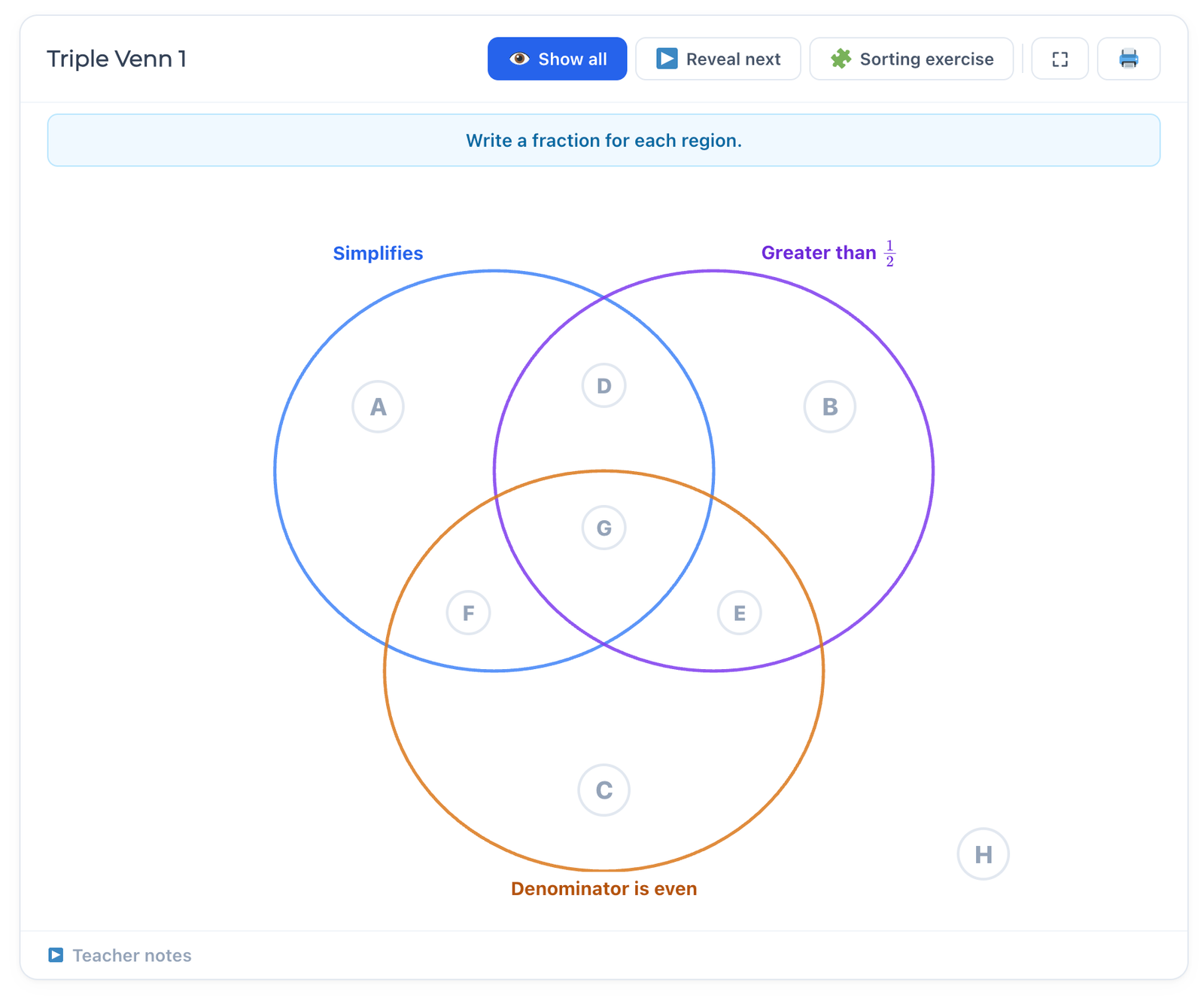
How Venn Diagrams work
Each diagram has two or three properties. The challenge is to find an example that fits each region, practising a core skill along the way.
Some regions may be impossible. Deciding which ones, and explaining why, is where the reasoning happens.
I have written more about making Venn Diagrams work in this post on purposeful practice.
Support and extension
A way in for students who are stuck, and ways to go further for those who finish.
If students are stuck
- 1
Do one together
Ask a student to suggest an example. Everyone writes on their mini-whiteboard the region they think it belongs in, then discuss the answer as a class.
- 2
Use the sorting exercise
Every diagram has a built-in sorting exercise. Students drag each example into the right region, then try to add examples of their own.
If students finish
- 1
Fewest and most
Which region has the fewest possible examples? Which has the most?
- 2
Go to the extremes
What is the biggest or smallest example you can think of for each region?
- 3
One nobody else will think of
Think of an example for this region that no-one else will think of.
- 4
Make your own
Can you create your own Venn Diagram on this topic with exactly one impossible region?
No Venn Diagrams match
Try fewer words, or a different word for the same thing.
Number


- Mental arithmeticTimes tablesKS1KS2KS3
4 double and 3 triple Venn Diagrams.
Also in: Factors, multiples and primes


- Factors, multiples and primes
4 double and 4 triple Venn Diagrams.
- Factors, multiples and primes
3 double and 3 triple Venn Diagrams.


- Fraction, decimal, percentage equivalence
4 double and 3 triple Venn Diagrams.


Algebra


Geometry


Statistics & Probability
- Averages and spread
4 double and 3 triple Venn Diagrams.


