Plenty in 20
Plenty of number practice in 20 questions, from Year 1 to GCSE.
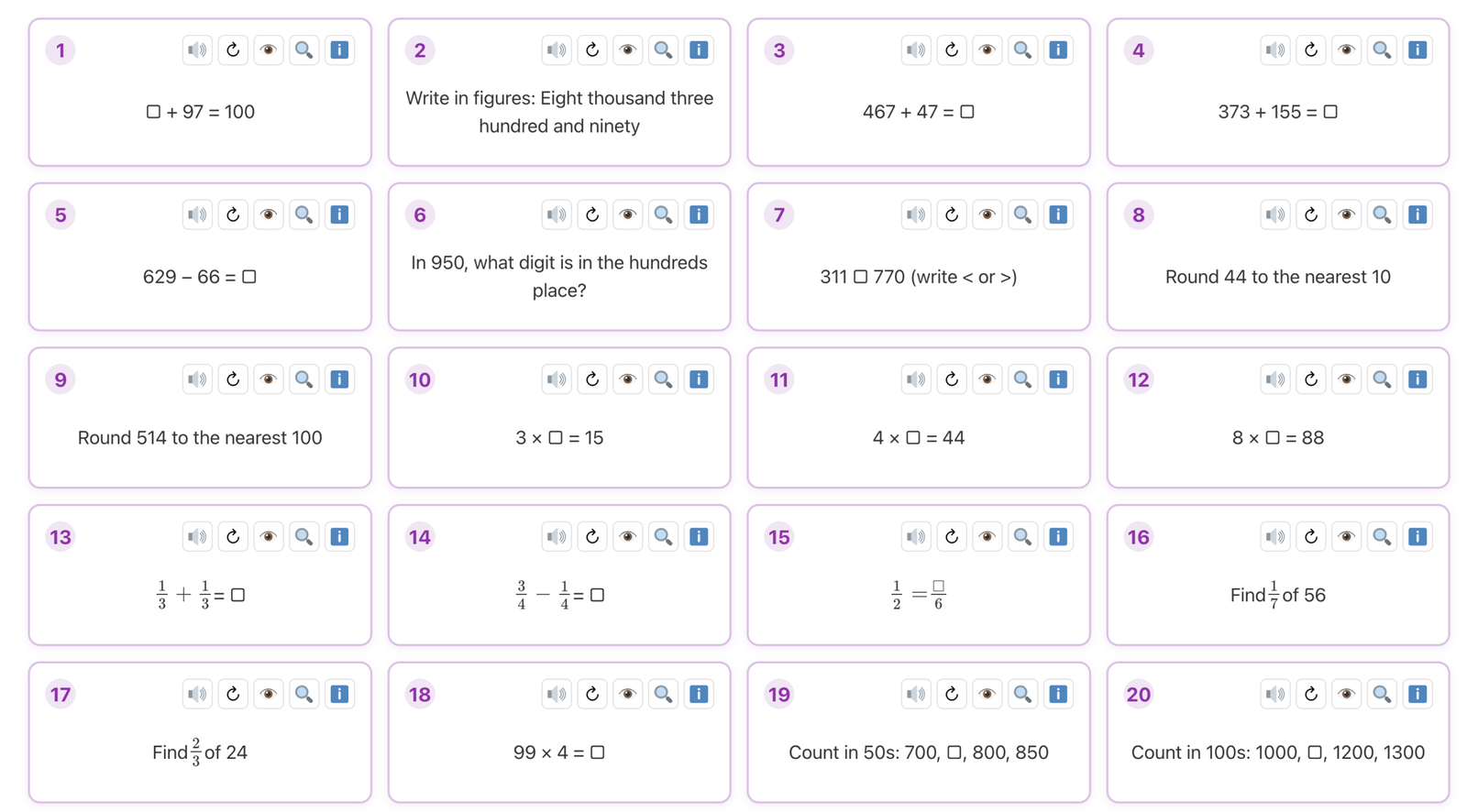
How Plenty in 20 works
Each level gives 20 quick questions on the number skills that matter most for one year group. Click once for a fresh set, reveal the answers, or open any question to see the full working.
Use it on the board, or print it as a one-page worksheet with answers.
The levels are named after gemstones rather than year groups, so you can choose the right level for any class or child without anyone knowing which year it is aimed at.
Primary Years 1 to 6
Six levels, from counting within 20 to fractions, percentages and ratio.
Quartz
Year 1
- Count forwards and backwards within 20
- One more and one less
- Number bonds within 10 and to 10
- Add and subtract within 10
- Count in 2s, 5s and 10s
- Tens and ones in teen numbers
All 20 skills
- Count forwards within 20
- Count backwards within 20
- One more than a number
- One less than a number
- Write numbers in figures
- Number bonds within 10
- Number bonds to 10
- Add two single-digit numbers
- Subtract within 10
- Double numbers to 10
- Count in 2s
- Count in 5s
- Count in 10s
- Compare numbers
- Order numbers
- Place value: tens and ones
- Partition teen numbers
- Missing numbers on a number line
- Add 10 to a single digit
- Subtract ones from teen numbers
Opal
Year 2
- Number bonds to 20
- Add and subtract 2-digit numbers
- 2, 5 and 10 times tables
- Divide by 2 and by 10
- Halves and quarters of amounts
- Place value to 100
All 20 skills
- Number bonds to 20
- Place value to 100
- Compare and order numbers to 100
- Write numbers in figures
- Count in 3s
- Add two 2-digit numbers (no regrouping)
- Add two 2-digit numbers (with regrouping)
- Subtract 2-digit numbers (no regrouping)
- Subtract 2-digit numbers (with regrouping)
- 2 times table
- 5 times table
- 10 times table
- Divide by 2
- Divide by 10
- Half of numbers to 40
- Quarter of numbers to 40
- Double 2-digit numbers
- Fractions of shapes
- Find 1/2 of a quantity
- Find 1/4 of a quantity
Amber
Year 3
- Number bonds to 100
- Add and subtract 3-digit numbers
- 3, 4 and 8 times tables
- Multiply 2-digit by 1-digit
- Round to the nearest 10 and 100
- Fractions: add, subtract, equivalent, of an amount
All 20 skills
- Number bonds to 100
- Write numbers in figures
- Add 3-digit and 2-digit numbers
- Add two 3-digit numbers
- Subtract 2-digit from 3-digit numbers
- Place value in 3-digit numbers
- Compare 3-digit numbers
- Round to the nearest 10
- Round to the nearest 100
- 3 times table
- 4 times table
- 8 times table
- Add fractions (same denominator)
- Subtract fractions (same denominator)
- Equivalent fractions
- Unit fraction of an amount
- Non-unit fraction of an amount
- Multiply 2-digit by 1-digit
- Count in 50s
- Count in 100s
Jade
Year 4
- 6, 7, 9, 11 and 12 times tables
- Factor pairs
- Add and subtract fractions; equivalent fractions
- Decimal tenths
- Recognise negative numbers
- Multiply and divide by 10 and 100
Plus the four written methods, place value and rounding
All 20 skills
- Written addition
- Written subtraction
- Written multiplication
- Written division
- Place value
- Rounding
- 6 times table
- 7 times table
- 9 times table
- 11 times table
- 12 times table
- Factor pairs
- Add fractions (same denominator)
- Subtract fractions (same denominator)
- Equivalent fractions
- Decimal tenths
- Write numbers in figures
- Recognise negative numbers
- Multiply by 10 and 100
- Divide by 10 and 100
Topaz
Year 5
- Add and subtract fractions with different denominators
- Mixed numbers and improper fractions
- Add and subtract decimals
- Percentages of amounts
- Square, cube and prime numbers
- Order of operations
Plus the four written methods, place value and rounding
All 20 skills
- Written addition
- Written subtraction
- Written multiplication
- Written division
- Place value
- Rounding
- Add fractions (different denominators)
- Subtract fractions (different denominators)
- Multiply fractions by integers
- Improper fractions to mixed numbers
- Mixed numbers to improper fractions
- Add decimals (2 dp)
- Subtract decimals (2 dp)
- Multiply and divide decimals by 10, 100, 1000
- Percentage of amounts
- Square numbers
- Cube numbers
- Prime numbers to 100
- Factors and multiples
- Order of operations
Ruby
Year 6
- Multiply fractions; divide fractions by integers
- Add and subtract mixed numbers
- Percentages of amounts; one number as a percentage of another
- Add and subtract negative numbers
- Simplify and share ratios
- HCF, LCM and order of operations
Plus the four written methods, place value and rounding
All 20 skills
- Written addition
- Written subtraction
- Written multiplication
- Written division
- Place value
- Rounding
- Multiply fractions
- Divide fractions by integers
- Add and subtract mixed numbers
- Percentage of amounts
- One number as a percentage of another
- Add negative numbers
- Simplify ratios
- Share in a ratio
- Subtract negative numbers
- Order fractions, decimals and percentages
- Order of operations (with brackets)
- HCF of two numbers
- LCM of two numbers
- Write numbers in figures
Key Stage 3 Years 7 to 9
Three levels that secure and extend number skills before GCSE.
Sapphire
Year 7
- Negative numbers: all four operations
- Convert and order fractions, decimals and percentages
- Fractions: all four operations
- Percentage increase and decrease
- Factors, multiples and primes
- Simplify and share in ratios
Plus the four written methods, place value and rounding
All 20 skills
- Written addition
- Written subtraction
- Written multiplication
- Written division
- Place value
- Rounding
- Add and subtract negative numbers
- Multiply and divide negative numbers
- Order negative numbers
- Convert between fractions, decimals and percentages
- Order fractions, decimals and percentages
- Equivalent fractions and simplifying
- Add and subtract fractions (different denominators)
- Multiply and divide fractions
- Percentage of amounts
- Percentage increase and decrease
- Square and cube numbers
- Factors, multiples and primes
- Simplify and share in ratios
- Order of operations
Emerald
Year 8
- Multiply and divide decimals
- Fractions and mixed numbers: all four operations
- Percentage change; express as a percentage
- Three-part ratios
- Direct and inverse proportion
- Powers and metric units
Plus the four written methods, place value and rounding
All 20 skills
- Written addition
- Written subtraction
- Written multiplication
- Written division
- Place value
- Rounding
- Multiply decimals
- Divide decimals
- Add and subtract mixed numbers
- Multiply fractions
- Divide fractions
- Percentage of amounts
- Express as a percentage
- Percentage change
- Three-part ratios
- Direct proportion
- Inverse proportion
- Calculate with powers
- Order of operations
- Metric units
Pearl
Year 9
- Round to decimal places and significant figures
- Estimation
- Complex fraction calculations
- Percentage change and multipliers
- Direct proportion and ratio problems
- Convert fractions, decimals and percentages
Plus the four written methods and ordering integers
All 20 skills
- Written addition
- Written subtraction
- Written multiplication
- Written division
- Order integers
- Rounding
- Round to decimal places
- Round to significant figures
- Estimation
- Multiply by powers of 10
- Complex fraction calculations
- Percentage change
- Fraction of an amount
- Negative number operations
- Percentage multipliers
- Direct proportion
- Multiply decimals
- Ratio problems
- Convert fractions, decimals and percentages
- Order of operations
GCSE Years 10 and 11
A Foundation and a Higher level for each year. Higher levels assume the Foundation skills.
Amethyst
Year 10 · Foundation
- Standard form: write and convert
- Percentage increase and decrease
- Add and subtract fractions and decimals
- Share in a ratio
- Convert and order fractions, decimals and percentages
- Estimation and best buys
Plus the four written methods, ordering and rounding
All 20 skills
- Written addition
- Written subtraction
- Written multiplication
- Written division
- Order integers
- Rounding
- Standard form (large numbers)
- Standard form (small numbers)
- Convert from standard form
- Percentage of amounts
- Percentage increase and decrease
- Add and subtract fractions
- Add and subtract decimals
- Squares and cubes
- Share in a ratio
- Convert fractions, decimals and percentages
- Order fractions, decimals and percentages
- Estimation
- Best buys
- Multiply by powers of 10
Onyx
Year 10 · Higher
- Standard form calculations
- Index laws, including negative, zero and fractional indices
- Compound percentage change, growth and depreciation
- Reverse percentages
- Fractions to recurring decimals
- Simplify surds
Plus the four written methods, place value and rounding
All 20 skills
- Written addition
- Written subtraction
- Written multiplication
- Written division
- Place value (standard form)
- Rounding
- Standard form (multiply and divide)
- Standard form (add and subtract)
- Index laws (multiply)
- Index laws (divide)
- Index laws (power of a power)
- Negative and zero indices
- Fractional indices
- Compound percentage change
- Compound growth and depreciation
- Fraction arithmetic
- Reverse percentages
- Fractions to recurring decimals
- Divide a line segment in a ratio
- Simplify surds
Garnet
Year 11 · Foundation
- Standard form calculations
- Compound percentage change and multipliers
- Ratio, inverse proportion and exchange rates
- Speed, distance, time
- Negative numbers; multiply and divide fractions
- Midpoints
Plus the four written methods, place value and rounding
All 20 skills
- Written addition
- Written subtraction
- Written multiplication
- Written division
- Place value (standard form)
- Round to significant figures
- Standard form calculations
- Index laws (positive)
- Compound percentage change
- Operations with negative numbers
- Inverse proportion (workers)
- Exchange rates
- Share in a ratio
- Speed, distance, time
- Round to decimal places
- Percentage multipliers
- Convert between fractions, decimals and percentages
- Fraction of an amount
- Find the midpoint
- Multiply and divide fractions
Diamond
Year 11 · Higher
- Surds: add, subtract, multiply, divide
- Rationalise denominators
- Negative and fractional indices; index laws
- Upper and lower bounds; error intervals
- Direct and inverse proportion
- Recurring decimals to fractions
Plus the four written methods, place value and rounding
All 20 skills
- Written addition
- Written subtraction
- Written multiplication
- Written division
- Place value (standard form)
- Round to significant figures
- Round to decimal places
- Multiply and divide surds
- Add and subtract surds
- Rationalise denominators
- Fractional indices
- Negative indices
- Index laws (all types)
- Upper and lower bounds
- Error intervals
- Multiply and divide decimals
- Direct proportion
- Inverse proportion (squared)
- Recurring decimals to fractions
- Standard form (negative powers)