Open Middle Problems
Problems with a closed beginning, a closed end, but an open middle — encouraging deeper thinking, multiple strategies, and mathematical reasoning.
What are Open Middle Problems?
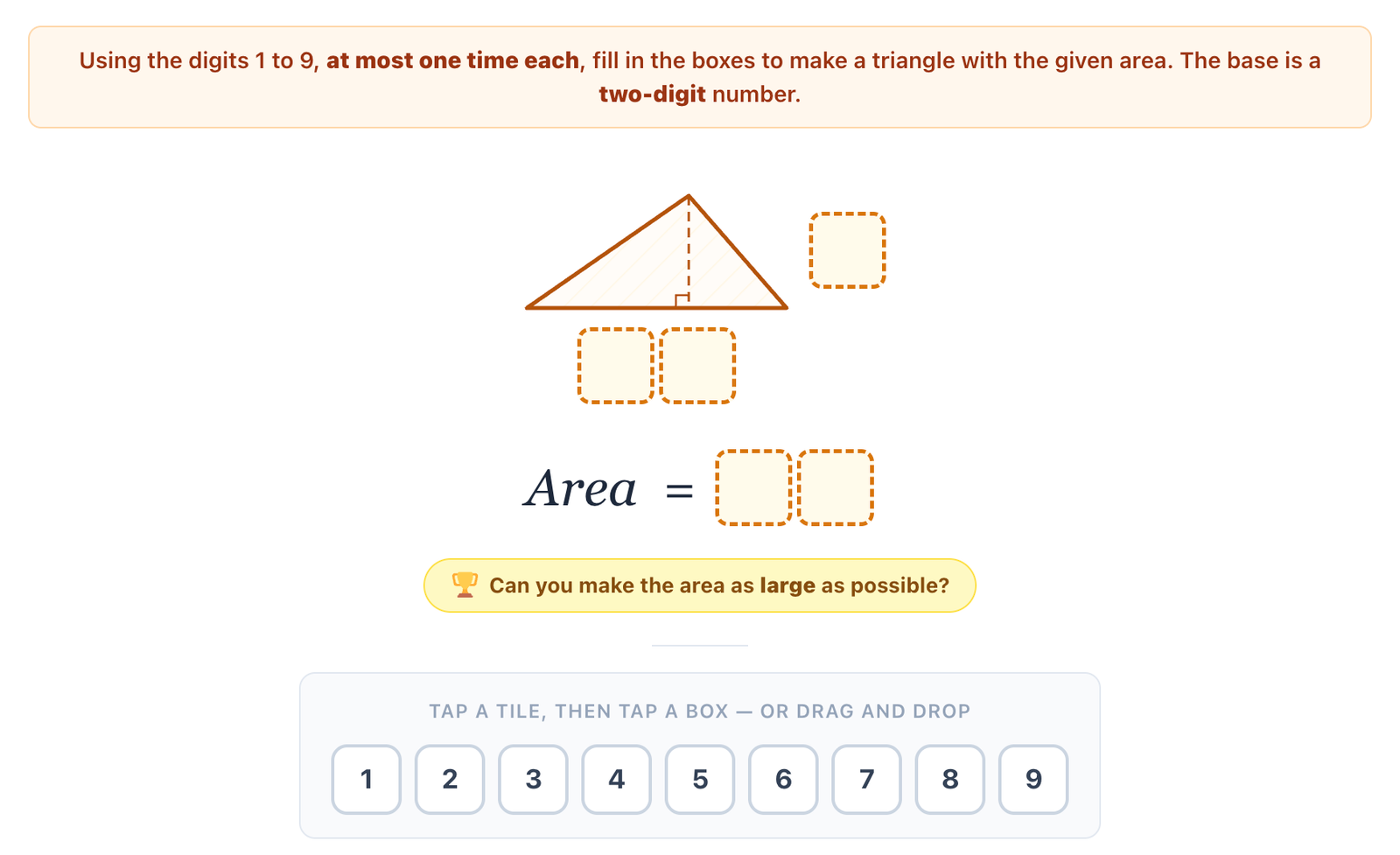
🔒 Closed beginning — every student starts with the same problem
🔓 Open middle — there are multiple ways to approach and solve it
🔒 Closed end — everyone is working towards the same answer
🏆 Optimise — find the biggest, smallest, closest, or most interesting solution
✅ Verify — check each other’s answers and strategies
How to Use Open Middle Problems
👩🏫
Teachers
Try an example together first to establish the rules. Give students mini-whiteboards for messy thinking — they will need to try, erase, and retry. Use the 4-2 approach: 4 minutes silent work, then 2 minutes sharing strategies with a partner.
Tip: Stop the class regularly to share the current “best” answer, get everyone to check it, then challenge them to beat it.
📚
Students
Start by choosing some numbers and testing them out. Don’t worry about getting the best answer straight away — the goal is to explore, learn from what doesn’t work, and gradually improve your solution.
Tip: Each problem has an optimisation challenge. Once you find a valid answer, ask yourself: can I do better?
👨👩👧
Parents
Work on the problem together — each try your own numbers, then compare strategies. These problems are great for showing that maths isn’t just about getting one right answer, but about thinking strategically.
Tip: Ask “Why did you choose that number?” and “What would happen if you changed this one?” to spark great conversations.
Tips for Making Open Middle Problems Effective
Four strategies to get the most out of these problems in your classroom:
Jump to Topic
Number
Integers
Decimals
Fractions
Rounding
Factors, multiples and primes
Negative numbers
Surds and indices
Algebra
Expressions and formulae
Brackets
Solving equations
Coordinates and graphs
Geometry
Statistics
Averages and range
Probability
I first heard about Open Middle Problems from Robert Kaplinsky on my podcast. The original collection, mapped to US Common Core Standards, is at openmiddle.com.
I’m adding new problems regularly — keep checking back for more! 🚀