Variation 6
Six carefully sequenced questions that reveal the hidden structure of every maths topic. Not random practice — deliberate variation designed to focus students’ attention on core concepts.
How Variation 6 Works
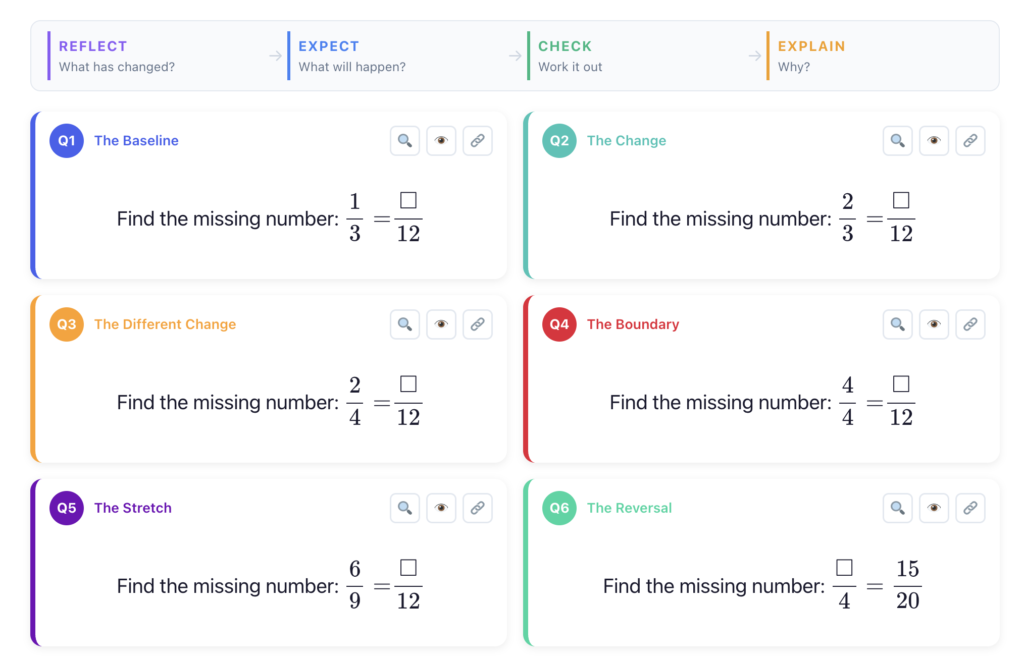
🔢 Six questions — on one concept, in a deliberate sequence
🔄 One change at a time — each question changes just one thing to focus student attention
🔁 RECE cycle — Reflect → Expect → Check → Explain from my book of the same name
👁️ Reveal or show all — show questions one at a time or all six
📝 Answers & notes — full working out and teacher connection notes
🖥️ Full-screen mode — for classroom projection
🖨️ Print ready — 1-page worksheet with teacher notes
How to Use Variation 6
👩🏫
Teachers
Project in full-screen and reveal questions one at a time. After each reveal, pause and ask: “What has changed? What do you expect will happen?” Use the 🔗 connections notes for ready-made discussion points — they explain exactly why each question was designed the way it was.
Tip: The teacher notes on the printed worksheet double as embedded CPD — read them while planning to deepen your own understanding of variation theory.
📚
Students
Work through all six questions in order — don’t skip ahead. Before you calculate each answer, compare it with the previous question: what changed? Can you predict what the answer will do? After you’ve worked it out, think about why. The “What do you notice?” space on the worksheet is where the real learning happens.
Tip: If you get stuck on Q5 (The Stretch), look back at an earlier question — the method is the same, only the numbers are less familiar.
👨👩👧
Parents
These activities help your child discover mathematical structure through careful comparison, not memorisation. Sit alongside them and ask: “What’s different about this question? What do you think will happen to the answer?” You don’t need to know the maths — the questions do the teaching.
Tip: The printed worksheet includes teacher notes on page 2, with answers and the reasoning behind each question.
Looking for a specific topic?
Find every resource mapped to every topic on one page.
Jump to Topic
Number
Integer place value
- Value of a digit — tens and ones
- Value of a digit — hundreds, tens and ones
- The role of zero
- Number names — two-digit numbers
- Number names — three-digit numbers
- Partitioning numbers (standard)
- Flexible partitioning
- Comparing numbers using place value
- Multiplying by 10 and 100
Mental addition and subtraction
- Number bonds to 10 and 20
- Addition within 20
- Subtraction within 20
- Adding a 1-digit number to a 2-digit number (no crossing)
- Adding a 1-digit number to a 2-digit number (crossing 10)
- Subtracting a single-digit number (no crossing)
- Subtracting a single-digit number (crossing 10)
- Adding and subtracting multiples of 10
- Adding a near-multiple of 10
- Subtracting a near-multiple of 10
- Adding two 2-digit numbers (no crossing)
- Number bonds to 100
- Adding two 2-digit numbers (crossing 10)
- Subtracting two 2-digit numbers (no crossing)
- Subtracting two 2-digit numbers (crossing 10)
- Adding across 100
- Subtracting across 100
Fractions
- Fractions of a shape
- Fractions of an amount (unit fractions)
- Fractions of an amount (non-unit fractions)
- Fractions on a number line
- Equivalent fractions
- Simplifying fractions
- Comparing fractions to a benchmark
- Comparing fractions
- Adding fractions (same denominator)
- Subtracting fractions (same denominator)
- Adding fractions (one denominator is a multiple of the other)
- Subtracting fractions (one denominator is a multiple of the other)
- Adding fractions (denominators share a common factor)
- Subtracting fractions (denominators share a common factor)
- Adding fractions (unrelated denominators)
- Subtracting fractions (unrelated denominators)
- Adding fractions — denominator diagnosis
- Improper fractions → mixed numbers
- Mixed numbers → improper fractions
- Adding/subtracting mixed numbers (same denominator)
- Adding/subtracting mixed numbers (different denominators)
- Multiplying a fraction by an integer
- Multiplying fractions
- Dividing a fraction by an integer
- Dividing an integer by a fraction
- Dividing a fraction by a fraction
- Four operations with fractions
- Multiplying and dividing with mixed numbers
Algebra
Expanding double brackets
Geometry
Basic angle facts
Angles in parallel lines
Statistics
Probability — with fractions
Probability — with decimals
I’m adding new activities regularly — keep checking back for more! 🚀