Categorical Atoms
Carefully sequenced teaching of the yes/no decisions students confuse most — designed to show exactly what makes each example yes or no.
How Categorical Atoms Work
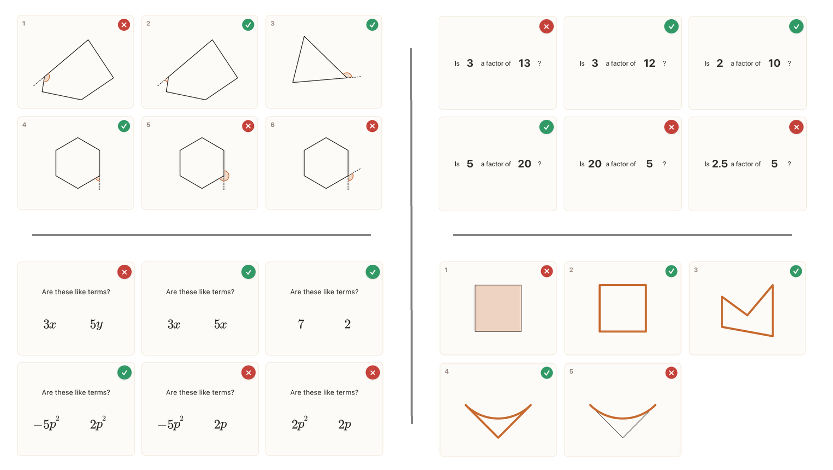
✓ A deliberate sequence of yes and no examples — every example doing a specific pedagogical job
✓ Minimal-change animations make the boundary between yes and no visible
✓ Maximally varied positive examples show what does — and doesn’t — matter
✓ Reveal the reasoning behind every example with one click
✓ Testing sequence with hand-picked misconceptions for consolidation
✓ Built-in teacher notes name the features and misconceptions in play
✓ Printable worksheets, answer keys, and teaching reference sheets
✓ Works on desktop, tablet, phone and interactive whiteboards
The Pedagogy of Categorical Atoms
Every atom on this page is built around a short teaching sequence that takes a specific shape: a non-example, three or more positive examples, then one or more closing non-examples. This NPPPN pattern comes from Direct Instruction, the approach to sequence design developed by Siegfried Engelmann and Douglas Carnine in Theory of Instruction (1991). Direct Instruction prescribes principles, not pattern strings: the yes/no boundary should be probed by minimal-change pairs (where exactly one feature differs); the positive examples should vary maximally across the things that don’t matter, to show that they don’t; and the closing non-examples should attack each critical feature one at a time.
The structure on this page is Kris Boulton’s adaptation of those principles for the secondary maths classroom. In his “How to Teach” series on the Unstoppable Learning Substack, Boulton calls NPPPN “a rock solid structure to get started with” — not the only structure, but the right rule of thumb when you’re new to the approach. The atoms here borrow his framing directly, and extend it where particular topics demand: atoms with three critical features become NPPPNN; atoms defined by the absence of a feature open with a positive rather than a negative; and so on.
A different tradition arrives at nearly the same recommendations through different vocabulary: Variation Theory (Ference Marton; Anne Watson and John Mason). Where Direct Instruction talks about minimum difference between consecutive frames, Variation Theory talks about contrast; where Direct Instruction talks about sameness across positives, Variation Theory talks about generalisation. Watson and Mason’s notion of “dimensions of possible variation and ranges of permissible change” is what lets a sequence designer choose three positives that defend a specific invariant, rather than three that just happen to look different.
What this means in practice is that every example is doing a specific pedagogical job, and so are the transitions between them. The animation between Example 1 and Example 2 isn’t decoration; it’s the lesson. The “Why?” button surfaces the reasoning each example is designed to teach. The teacher notes panel on each atom names the critical features being probed and the misconceptions being attacked. Categorical atoms are short, but they are not light.
How to Use Categorical Atoms
👩🏫
Teachers
A complete teaching tool for the yes/no decisions students mix up most often. Every example in every sequence is doing a deliberate pedagogical job — use the animated teaching sequence to introduce a concept on the board, then set the testing sequence — on screen or as a printable worksheet — for consolidation.
Tip: Open the built-in teacher notes before you teach — they flag the misconceptions each example is designed to probe!
📚
Students
When you keep getting muddled about whether something is or isn’t an example of something, work through the teaching sequence and watch exactly what changes between examples. Then test yourself on the testing sequence to make sure it’s stuck.
Tip: Click “Why?” on every example — even the easy ones. The reasoning is the point.
👨👩👧
Parents
Each atom focuses on a single yes/no question your child might be uncertain about. The animated examples and built-in reasoning mean no preparation needed — just open the page and explore together.
Tip: Watch the teaching sequence together first, then let your child try the testing sequence on their own!
Looking for a specific topic?
Find every resource mapped to every topic on one page.
Jump to Section
Number
✖️
Is this a factor?
Is one number a factor of another? Tests whether students apply the divides-exactly definition rather than guessing from familiar times-table pairs.
🔢
Is this an integer?
Is this number an integer? Tests negatives, zero, fractions, decimals, and the boundary cases where surface form and value diverge.
🎲
Is this an odd number?
Is this number odd? Tests whether students check the last digit alone — rather than the first digit, or how many of the digits are odd.
🥧
Is one-quarter shaded?
Is exactly one-quarter of the shape shaded? Tests whether students check that the whole is split into four equal parts — not just four parts — before counting what’s shaded.
🔬
Is this written in standard form?
Is the number in standard form? Tests both halves of the form — a number between 1 and 10, multiplied by an integer power of 10 — under varied notation.
Algebra
🔤
Is this a term?
Is this a single term? Tests whether students can tell one term apart from several terms joined by adding or subtracting — however long or complicated the term looks.
🧩
Are these like terms?
Are two terms “like” each other? Tests whether students attend to the variable part of each term — same letters, same exponents — and ignore the coefficients.
📈
Is this a quadratic expression?
Is this expression quadratic? Tests whether students check that the highest power of the variable is 2 — whatever else the expression contains, and however it is arranged.
Geometry
⬜
Is this a square?
Is the shape a square? Tests whether students check three critical features — four sides, all equal, all right angles — rather than judging by eye.
🔺
Is this a triangle?
Is the shape a triangle? Tests three critical features — three sides, all straight, fully closed — against shapes designed to look triangular at a glance.
🔄
Is this the perimeter?
Is the highlighted path the perimeter? Tests whether students recognise a complete traversal of the outer boundary — including with sectors, compound shapes, and partial-perimeter traps.
🔻
Is this an exterior angle?
Is the marked angle an exterior angle of the polygon? Tests whether students check that the angle sits between a side and its extension — not between two sides, and not anywhere else on the figure.
📏
Are these angles on a straight line?
Do these marked angles tile a straight line? Tests whether students check that the angles share a single vertex on the line and fully tile the half-plane above it.
Statistics
📊
Is this continuous data?
Is the data being recorded continuous? Tests whether students decide by what is actually being measured or counted — not by cue words like “the number of” or whether a unit is given.